Dear Diary,
Hi, I am Hari Om Vashishtha (x), hov8a (Insta), hov8a (In)
You are currently experiencing Chapter 21.5 of my life: Are You Agentic Enough, Yet?

Note that whenever i add a new chapter to my life, i do not mean to close any of the previous ones & most things are often fuzzy.
So your inference about any of it would be incomplete. Please make minimum assumptions.
NOW
While taking care of my dementia ridden 88 years old grandpa, Honorary Capt. Ramphool Sharma Ji, almost 24X7, I am working on a long-term project.
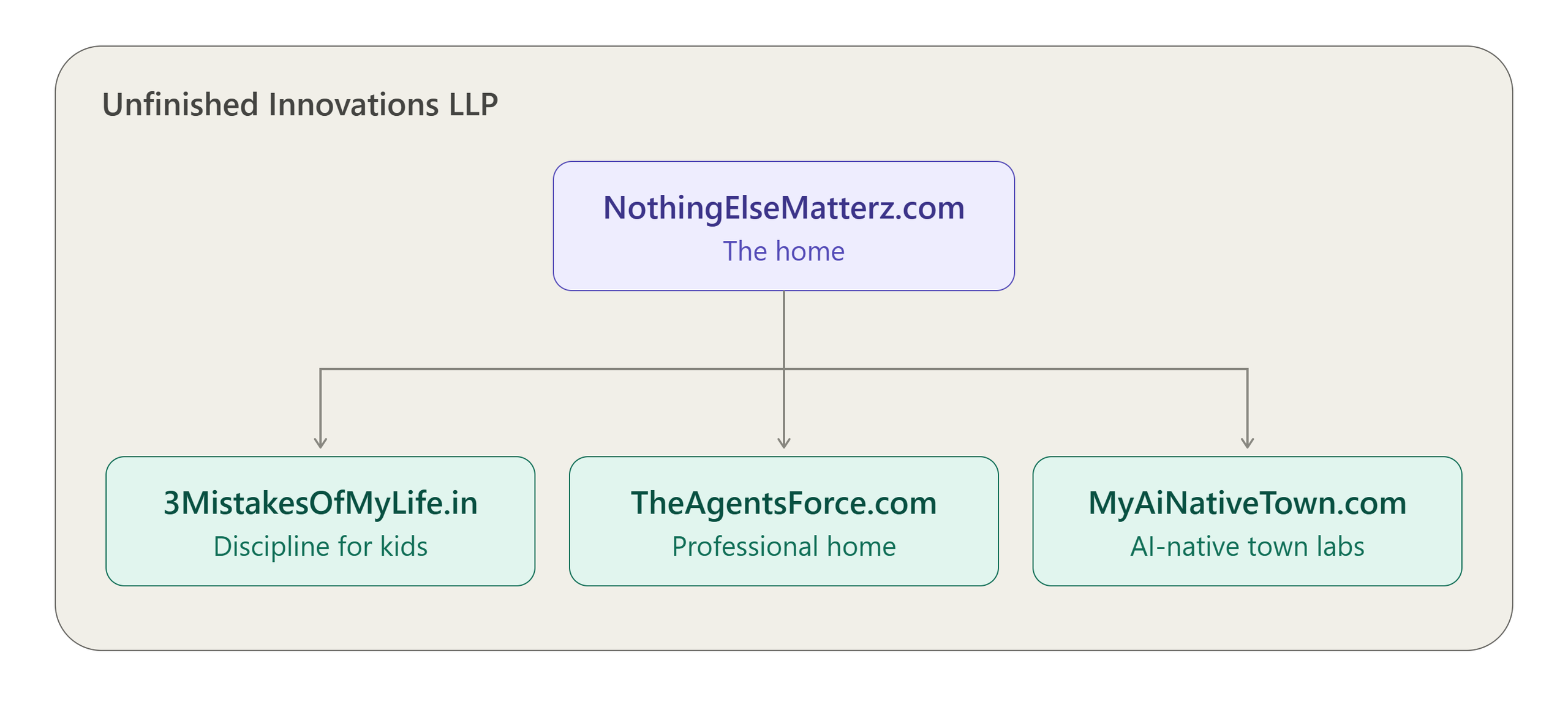
- 3MistakesOfMyLife.in: A discipline training program, for kids & adults.
- TheAgentsForce.com: Rebuilding my professional internet presence, enabled by agents. 🙂
- MyAiNativeTown.com: An AI-native town is not a smart city with AI bolted on. The system does not wait for AI-native users. The system is the thing that makes them AI-native. (the Manifesto)
I am creating a lot of funnels these days on Twitter, YouTube, Instagram, LinkedIn & #NothingElseMatter.com, all boiling down to revenue in the bank, in the long run.
In short, currently, I am building Salesforce Agent Force Mindset.
Phase 2: Generate Revenue (Since Feb, 2024)
| Sr No. | Subject of realized iteration |
|---|---|
| Chapter 21.5 | Are you agentic enough, yet? {DRAFT} |
| Chapter 21.4 | Trust as a funnel. {My funnel thesis got some validation. So here’s my million dollar offer.} |
| Chapter 21.3 | HiDevs <> Hari Om Vashishtha {Unfinished Innovations LLP} Collaborations |
| Chapter 21.2 | Goal: Generate a $1M, For My (Salesforce) Clients, by 31st December 2026…!! 💝🎯🤘🤓 |
| Chaper 21.1 | Generate Revenue NOW, FunnelsExperiment #015 (By building Salesforce Agentforce Agents). Agent: God Complexes) |
| Chapter 20 | 3 Mistakes Of My Life (A discipline training program, for kids & adults)... I guess, I will have to divide the chapter 20 into multiple parts, going deeper into my why and how. After learning the importance of writing, self exploration, goals, funnels, processes & iterations in the last 4-5 years, 1st January 2025, I am launching another MVP as www.3MistakesOfMyLife.in. (chapter 20.1) We need to be very careful about what learning tools we are building for the next generation, right? & So, somewhere down the line, it’s also about global self awareness of humanity. Isn’t it a multi-billion dollar opportunity? But let’s take it slow. We’ll break it down & move forward by validating hypothesis along the way. Insights behind the project Most humans: 1. are not disciplined. 2. do not care about their goals. 3. do not do what they say, they’ll do. 4. do not have empathy at their core principles. 5. struggle with achieving their minimal goals. |
| Chapter 19.1 | Let us build some more funnels from scratch. |
| Chapter 19 | Me-As-A-Service / Evangelism-As-A-Service |
| Chapter 18 | Draft: I have an MVP as a PRD in a Document with Some clarity Along with a Thesis & too Many Assumptions but NO financials, yet. |
| Chapter 17 | The Ultimate PM FunnelsExperiment #009 & #010 (To Optimize For Incoming Product Opportunities) |
| Chapter 16 | My Experimentational Approach to Generate Revenue. |
Phase 1: The Story Of Our Origin, The Developments And The Goal (Since September 2021)
| Sr No. | Subject of the writeup |
|---|---|
| Chapter 1 | What is EdTech (for me) & Why only edtech? |
| Chapter 2 | Why Gamification of Education..?? |
| Chapter 3 | Letter to self from 2032: Let them play. |
| Chapter 4 | Who is Mini? |
| Chapter 5 | Mini Version 0.1 (tell stories and ask questions) |
| Chapter 6 | Everything about conversations |
| Chapter 7 | What is a conversation |
| Chapter 8.1 | Interactive communication |
| Chapter 9 | The Tough Conversations |
| Chapter 10 | A conversation with myself |
| Chapter 11 | Consistency Framework (For Self For Now) |
| Chapter 12 | GrowUpWithHarita.com (Baby Products Store Coming Soon) |
| Chapter 13 | My Amazon Store |
| Chapter 14 | Harita Ki Maa Sarita (My Wife’s YouTube As Our Best Top of the Funnel) |
| Chapter 15 | Encourage Positive Parenting “Conversations” (MVP) |
2021: Inception of Project 2032
This is where I started building my dreams in more structured manner with Chapter- 1, when i was about to be a father for the first time. I think I had slowly realized that I need to play the long term games. I think I also found a mentor about that time and the trajectory changed from there & so the evolution making it a milestone year.
Phase: 0, Chapter 0: 2010-2020
2015-2020
2019-2020
ZipGrid.com… Wow, 15 days at home in Haryana and 15 days at office, in Sakinaka Mumbai.
2018-2019
Bridgelabz happened when i had to rush to Mumbai from North India, just before my marriage.
2015-2018
Mettl.com & my longest professional stint role where i was fired 3 times. Damn… 😛
2015: https://twitter.com/xengaging
Should I call it one of my random musings?
2013: TheWittyShit.com
A business idea that wasn’t even my own but paying to own it felt like a start.
2012 a platform for creative local businesses to create their online presence and socialize.
Another random noon, A school friend from 2006 came up to me to discuss a venture possibility because I knew how to build websites.. 🙂 However, WayBackMachine doesn’t have a clear picture of what we built using Joomla. It’s really a love story to be written someday.
It was 2010, One evening fresh out of college:
I was lying in bed on a mattress on the ground in a building somewhere in Noida where I was living with my cousin brother Kapil & his friends. I saw a dream with my open eyes to build an online blog. That was the first time I thought of buying a domain name on the internet. But being a fresh computer graduate, I knew that was going to be easy.
So, I brought NothingElseMatterz.com. Maybe, I was also confident because, By that time, my cousin brother Kapil had already done one experiment to build an online business with his college friends under the brand name Clubdukes.com & Addukes.in. Well, the WayBackMachine has a good memory of what I built. 🙂 But I had no clear goals attached to it.
Why did I buy NothingElseMatterz.com:
- Of course, the song, Nothing Else Matters by Metallica was often buzzing in my head ever since I heard the same, maybe back in 2006, i.e. about 4yrs ago.
- & The domain name NothingElseMatters.com wasn’t available.
Do I live my life by the lyrics of the song?
Sometimes, I am also available as a Freelancer, You can send me an offer directly on Upwork.
What did I learn in all that jazz? Aggression and patience both are necessary at the same time to build something useful. If I am really a founder material who can create a useful valuable Product worth billions of dollars, only time will tell. 🙂
PS: Contracts, invoices and collaborations happen through Unfinished Innovations LLP, my legal entity.
If any of it intrigues you…
& empower each others’ funnels.
PS: Here’s my definition of the term conversation: 👇
definition of the term CONVERSATION:
— Hari ॐ Vashishtha (Agentforce) 🤘 (@hov8a) March 31, 2026
Iteration #4
A Conversaton Is A Very Scientific Event, In Multiple Funnels At The Same Time,
Involving Many Forces Of The Nature, To Yielf Maximum Benefits For All The Involved Parties,
Depending Upon The Match In Freqnencies, Intents… https://t.co/R61dyWldNU pic.twitter.com/helYGq6gKE